

How to Choose Ceiling Lights for Offices and Retail Projects Without Compromising on Energy Efficiency

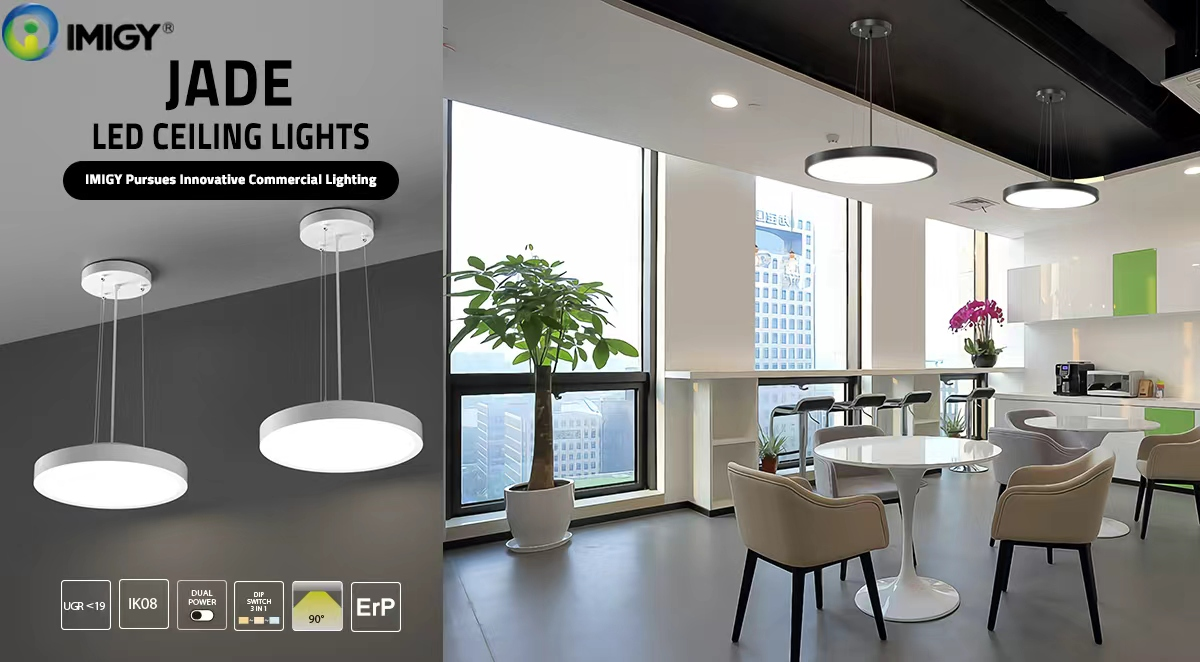
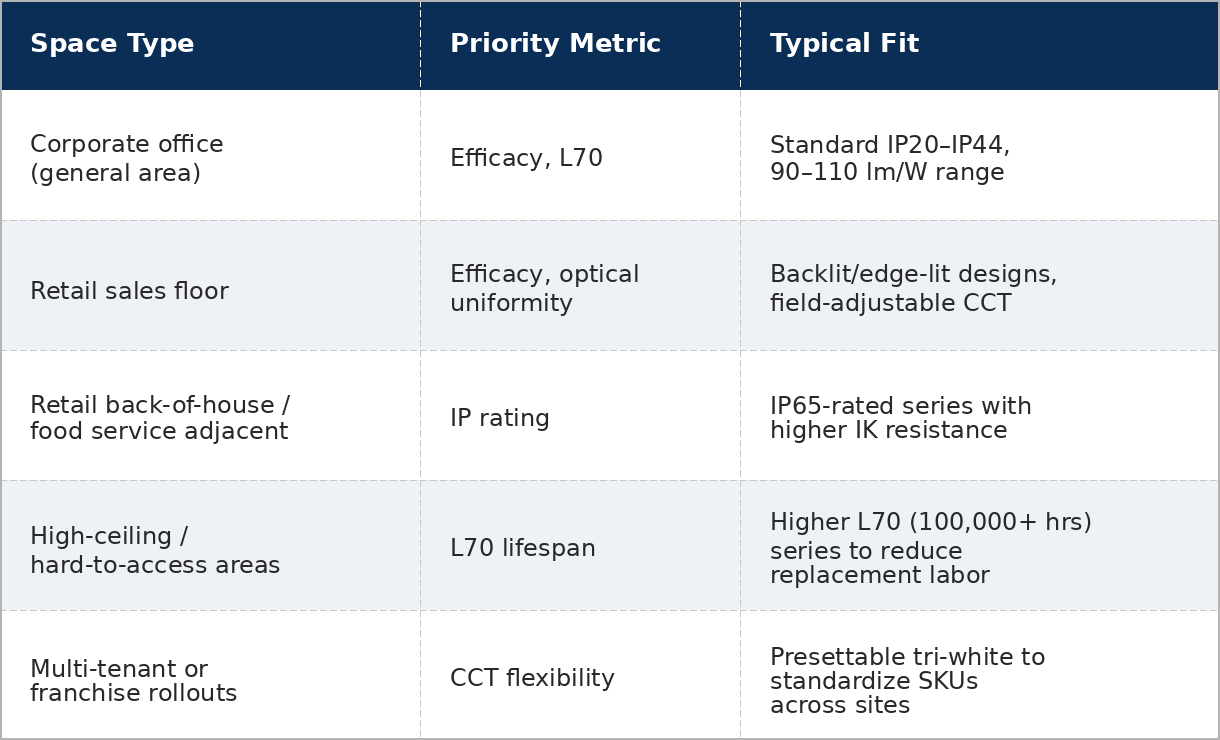
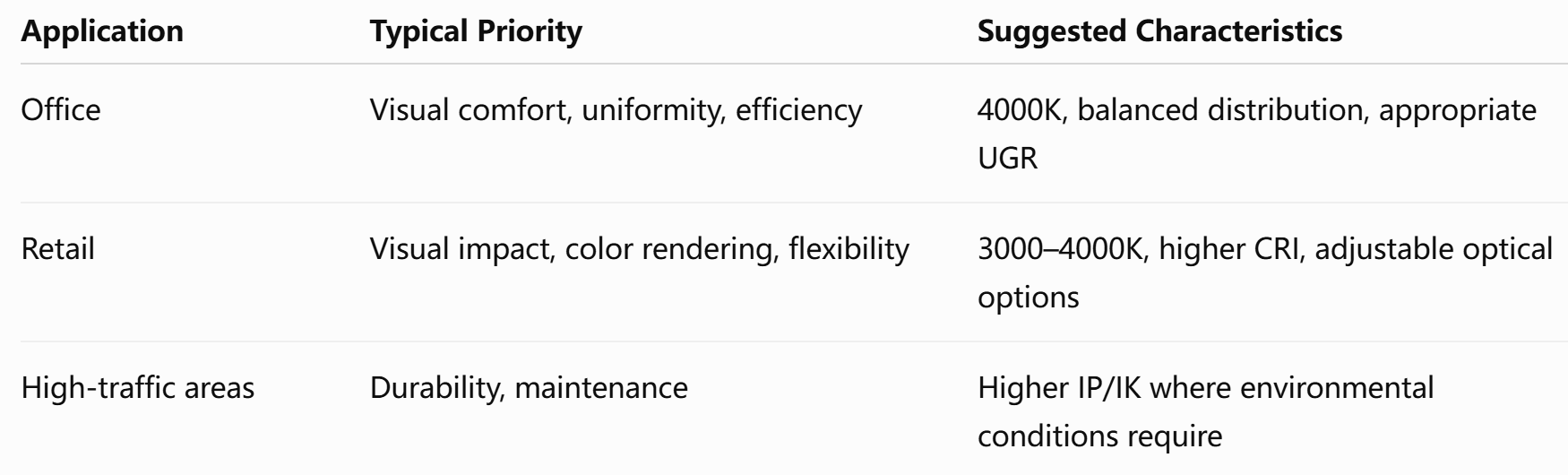
Energy-efficient commercial ceiling lights are best selected by comparing three metrics together—lumen maintenance (L70), driver efficiency, and optical distribution—rather than judging fixtures by price or wattage alone. Across current Ceiling Lights for Offices and Retail Projects, efficacy commonly ranges from 90 to 125 lumens per watt, with reported L70 ratings ranging from 85,000 to 120,000 hours depending on the series. Matching the right combination to office versus retail use cases is what actually protects both the energy budget and long-term maintenance costs.
Key Takeaways
Efficacy (lm/W)—not wattage—determines real energy performance; commercial ceiling light lines here range from roughly 90lm/W to as high as 125lm/W depending on series and configuration.
Reported L70 ratings vary meaningfully by series, from around 85,000 hours up to 120,000 hours on select backlit designs—always check the specific SKU rather than assuming a blanket number.
IP and IK ratings vary widely across ceiling light series (from IP20 general-purpose to IP65/IK10 for high-traffic or washdown-prone areas), and picking the right one avoids both over-spending and premature failure.
Field-adjustable 3CCT (presettable tri-white) reduces SKU complexity for distributors and lets installers match color temperature to the space without stocking multiple fixed-CCT models.
Certification matters for handover: confirm CE documentation is available for the specific ceiling light product line being specified, not just the brand in general.
Q&A
Q1: What's the most reliable way to compare energy efficiency between ceiling light fixtures?Compare lumens per watt (efficacy), not wattage. Within commercial ceiling light ranges, efficacy commonly spans roughly 90–125lm/W depending on the series and optical design—two fixtures drawing the same wattage can differ meaningfully in actual light output per watt consumed.
Q2: Does a longer L70 rating always mean a better fixture?Not automatically, but it's a meaningful differentiator. Standard commercial ceiling lights typically carry L70 ratings from 59,000 to 85,000 hours, while select backlit designs are rated up to 120,000 hours. A longer L70 rating indicates longer projected lumen-maintenance performance, but it should not be treated as a guarantee of full-fixture service life. It can be particularly useful in high-ceiling or hard-to-access installations where maintaining light output over a long operating period is important.
Q3: What IP rating is appropriate for office and retail ceiling lights?It depends on the space. Standard dry office and retail interiors are well served by lower IP ratings; spaces with more airborne dust, higher cleaning frequency, or exposure to moisture may benefit from higher IP protection, while areas with greater impact risk should also be specified with an appropriate IK rating. Matching the rating to the actual environment—rather than defaulting to the highest available—keeps the budget efficient.
Q4: Is field-adjustable color temperature (3CCT) worth specifying?Yes, for most commercial projects. A presettable tri-white fixture lets the installer select 3000K, 4000K, or 5700K on site and retains that setting through power cycles, which simplifies inventory for distributors and gives design flexibility late in a project without needing to special-order fixed-CCT units.
Q5: What product information should I verify when specifying ceiling lights for an energy-efficient or green-building project?Ask for the specific efficacy (lm/W), L70 rating, energy-related performance data and control compatibility for the exact SKU being quoted. Where relevant to the project certification system, also request environmental or product documentation required by the project's specification. CE documentation should be verified separately as evidence of applicable EU product compliance.
Core Metrics That Actually Drive Energy Performance
Lumen maintenance (L70). Standard commercial LEDs lose output over time, and the L70 figure marks when a fixture has degraded to 70% of its initial lumen output. Specifying fixtures with a low L70 rating to compensate with excess initial brightness inflates both capital cost and electrical infrastructure sizing. Premium backlit ceiling light designs in current commercial ranges reach reported L70 ratings as high as 120,000 hours, indicating longer projected lumen-maintenance performance than fixtures rated at 59,000–85,000 hours.
Driver architecture. Driver quality affects both energy loss (as heat) and long-term reliability. It's worth noting that most <a href="https://www.imigyled.com/application.html">commercial ceiling light</a> fixtures—including several higher-efficacy series—use internal non-isolated drivers rather than isolated designs; isolated drivers appear on select higher-wattage or specialty SKUs. Driver topology should be confirmed at the SKU level rather than assumed from a general efficiency claim, since it affects compatibility with dimming and control systems more than it affects raw efficacy.
Optical distribution. How light is directed matters as much as how much is produced. Backlit and edge-lit optical designs—now common across several commercial ceiling light series—distribute light more evenly across the work plane than older diffuser-only designs, reducing the wattage needed to hit the same target illuminance.
Comparing System Efficacy Across Product Categories
As a broad market reference, some conventional commercial LED ceiling fixtures operate around 80–95 lm/W, while more recent high-efficiency designs can reach 100–125 lm/W or higher depending on fixture type, wattage and configuration. Several current commercial ceiling light series exceed this range, reaching 100–125lm/W depending on wattage tier and configuration—meaning a facility can often hit the same target illuminance using meaningfully less connected wattage per fixture, without resorting to unverified facility-wide percentage projections that vary heavily by building type, occupancy schedule, and local energy rates.
Application Guide
Failure Mechanism: Why "Efficient" Fixtures Sometimes Underperform in the Field
Facility managers often observe that a fixture's rated efficacy and its real-world energy performance diverge when the driver or optical design doesn't match the installation context.
Why: A high lm/W rating measured under lab conditions assumes the driver is operating within its designed thermal and electrical envelope.
How: Poor ventilation above the ceiling void, incompatible dimming controls, or operating the fixture outside its specified electrical conditions can quietly erode real-world performance even when the datasheet rating is accurate.
What this looks like in the field: Utility bills that don't drop as much as projected after a "high-efficacy" retrofit—usually traced back to installation conditions or control mismatches rather than the fixture itself being misrated.
Industry Standards Referenced
L70/L90 lumen maintenance ratings are derived from LM-80 LED chip test data, projected using the TM-21 method.
IP ratings follow IEC 60529; IK impact ratings follow IEC 62262.
CE marking confirms compliance with applicable EU health, safety, and environmental protection directives for the specific product category—verify the certificate is issued for the ceiling light product line being specified, not assumed from general brand-level compliance.
Procurement Checklist
✓ Certification — Request CE documentation specific to the ceiling light product line
✓ Efficacy (lm/W) — Compared at the SKU level, not assumed from a series-wide average
✓ L70 rating — Confirmed for the specific wattage/configuration being quoted
✓ IP/IK rating — Matched to actual environmental exposure, not defaulted to the highest available
✓ Driver architecture — Confirmed compatibility with any planned dimming or control system
✓ CCT flexibility — Field-adjustable (presettable tri-white) vs. fixed CCT, based on project rollout needs
✓ Warranty terms — Typically 3 years standard across commercial ceiling light lines; confirm against the specific SKU
Which Approach Fits Which Project
For projects mixing office and retail zones, <a href="https://www.imigyled.com/company.html">IMIGY</a>'s ceiling light range spans several practical tiers: backlit designs with L70 up to 120,000 hours and IP64 protection for high-traffic areas needing minimal maintenance; edge-lit slim-profile series reaching up to 125lm/W for energy-focused office rollouts; and IP65/IK08–IK10-rated lines for retail zones with higher cleaning frequency or impact risk. Matching series to zone-specific priorities—rather than standardizing on one SKU across a mixed-use property—is what actually delivers the efficiency gains referenced above.
Website: <a href="https://www.imigyled.com/">https://www.imigyled.com/</a>
FAQ
What efficacy range should I expect from commercial ceiling lights? Roughly 90–125lm/W depending on series and wattage configuration; always confirm at the SKU level.
What does L70 mean and why does it vary so much between fixtures? It marks when output has degraded to 70% of initial lumens; the variation reflects differences in thermal design, driver quality, and LED chip selection between series.
Is a higher L70 rating always better value? Generally yes for long-term operating cost, especially in hard-to-access installations, though it should be weighed against upfront price difference for the specific project's expected building lifespan.
What IP rating do standard office ceiling lights need? Standard dry offices typically don't require high IP ratings; reserve higher IP/IK ratings for zones with actual moisture, dust, or impact exposure.
What is presettable tri-white and why does it matter for large rollouts? It's a field-adjustable CCT feature (commonly 3000K/4000K/5700K) that retains the selected setting after power loss—useful for multi-site rollouts needing consistent appearance without stocking multiple fixed-CCT SKUs.
Do all commercial ceiling lights use isolated drivers? No—many higher-efficacy series use internal non-isolated drivers; isolated driver architecture is more common on select higher-wattage or specialty configurations. Confirm at the SKU level.
How should I estimate energy savings from switching to higher-efficacy ceiling lights? Compare the actual lm/W and wattage of the specific fixtures being considered against your current installation, and calculate based on your facility's real operating hours and local electricity rates rather than relying on generic industry-wide percentage claims.
What certifications should I request before specifying? CE documentation for the specific ceiling light product line; ask the supplier directly for the certificate rather than assuming it from general brand compliance claims.
Does optical design (backlit vs. diffuser) really affect energy use? Yes—more uniform light distribution reduces the wattage needed to hit a target illuminance level, independent of the LED chip's own efficacy rating.
What warranty is typical for commercial ceiling lights? 3 years is common across several current commercial lines; always confirm against the specific SKU being quoted.
IMIGY Lighting
IMIGY Lighting
email us here
Legal Disclaimer:
EIN Presswire provides this news content "as is" without warranty of any kind. We do not accept any responsibility or liability for the accuracy, content, images, videos, licenses, completeness, legality, or reliability of the information contained in this article. If you have any complaints or copyright issues related to this article, kindly contact the author above.
