

IMIGY Issues Technical Analysis on Long-Term Reliability of IP65 LED Downlights in Commercial Architecture
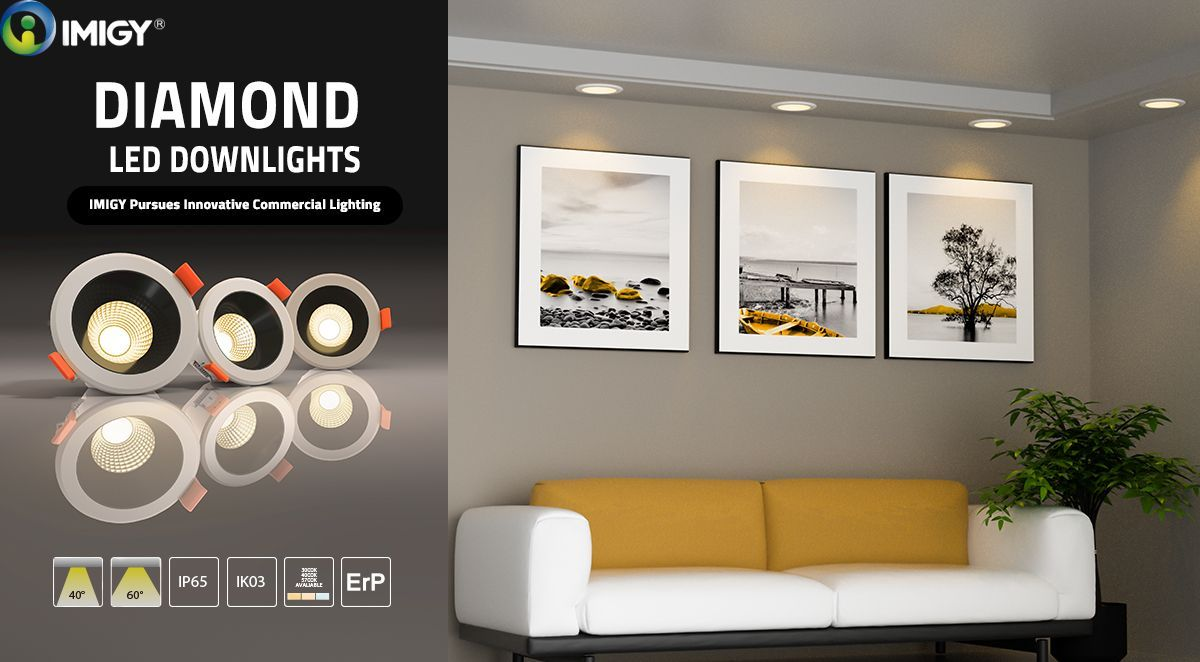
Technical Standards and Environmental Testing under IEC 60529
According to the international standards established under IEC 60529, an IP65 rating signifies that a luminaire is completely dust-tight and resistant to low-pressure water jets from any direction. The first digit requires the fixture to withstand continuous exposure to fine dust particles within a sealed testing chamber for at least eight hours without any internal contamination. The second digit mandates that the housing resist water projected through a 6.3 mm nozzle at a flow rate of 12.5 liters per minute from all operational angles.
When these specifications are overlooked during commercial procurement, the structural vulnerability of lower-rated fixtures often leads to rapid component degradation. In high-traffic spaces such as retail entrances, building lobbies, and shopping mall corridors, unsealed fixtures regularly fail due to two specific environmental pathways.
The first pathway involves particulate accumulation. Airborne dust, fiber particles, and aerosolized cleaning agents pass through minute housing gaps and gradually coat internal electronics and heat sinks. This accumulation acts as thermal insulation, raising the operating temperature of the LED driver. Because a 10-degree-Celsius increase above the rated operating threshold roughly halves capacitor lifespan, the driver often degrades and fails well ahead of its engineering schedule.
The second pathway stems from moisture cycling. Daily temperature fluctuations and shifting HVAC patterns drive ambient humidity through structural micro-gaps. The resulting internal condensation corrodes solder joints, leading to intermittent lamp flickering and ultimate fixture failure.
Structural Engineering and Field Performance Realities
Sustaining an IP65 rating across large-scale manufacturing volumes requires deliberate structural design choices. Lab certification is distinct from field survivability, which relies on precise engineering tolerances. A primary requirement is controlled silicone gasket compression at the interface between the optical lens and the main housing body to eliminate structural gaps. Furthermore, the selection of housing materials remains vital. Die-cast aluminum maintains dimensional stability across thousands of thermal expansion cycles, whereas injection-molded polymers tend to creep and distort over time, compromising previously secure joints.
Advanced configurations also isolate the LED driver into a separated chamber, away from the main optical cavity. This separation reduces the internal thermal gradient and prevents the pressure differentials that draw moisture toward the circuit board. To validate these methods, engineering tests conducted on sealed commercial downlights demonstrate that structurally integrated gaskets maintain stable lumen output and performance over much longer periods than non-rated alternatives.
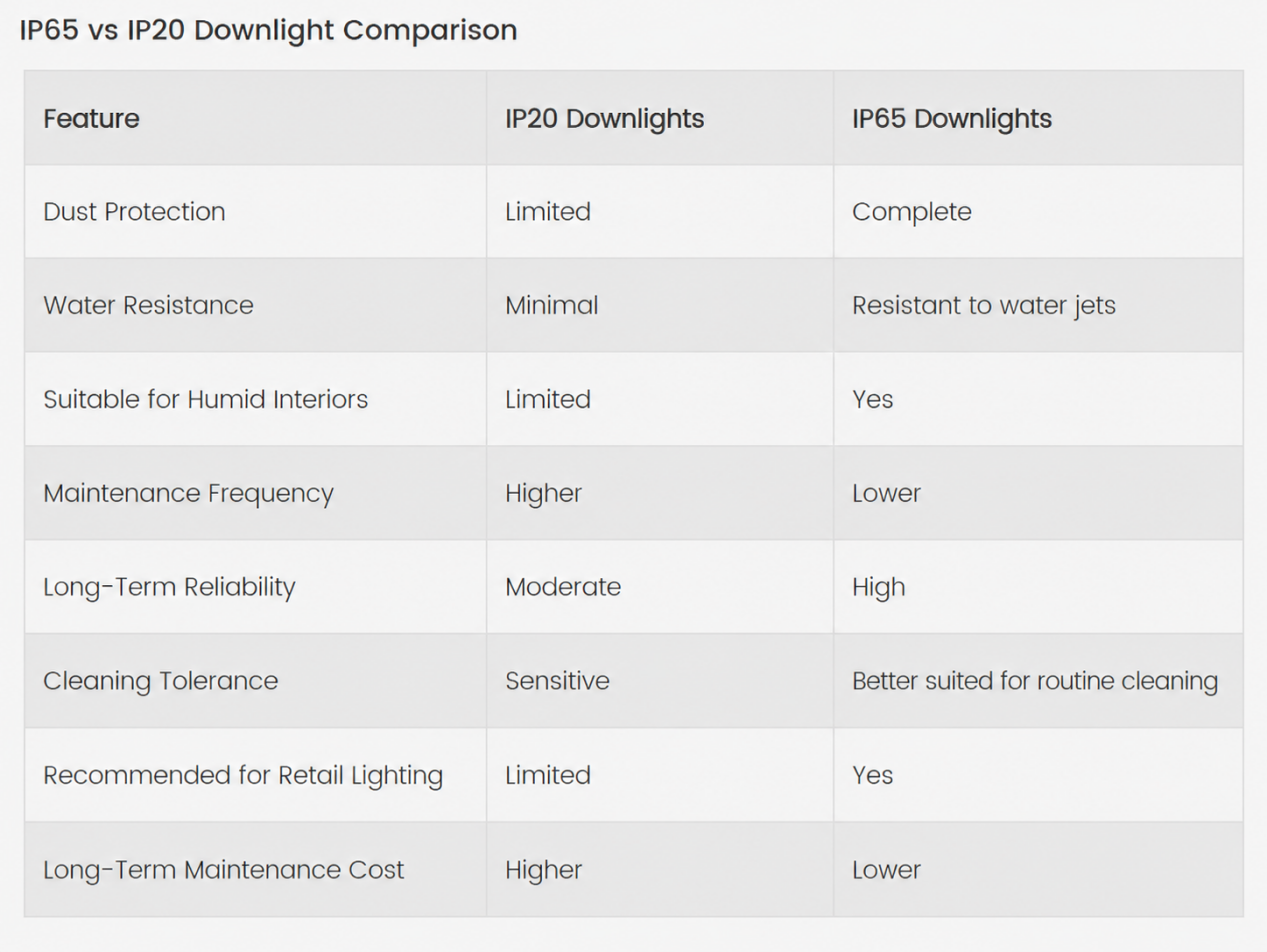
The operational differences between IP65 and standard IP20 fixtures become starkly evident in long-term facility maintenance logs. Field data shows that IP20 fixtures installed in humid or high-traffic commercial interiors frequently exhibit failure rates exceeding 20 percent within the first two years, whereas properly sealed IP65 alternatives regularly maintain failure rates below 3 percent under the same conditions.
Similarly, while unsealed installations generally require maintenance intervention every 14 to 16 months, IP65 equivalents routinely extend service intervals to between 36 and 40 months. Over a five-year operational window, the cumulative maintenance cost for an IP20 fixture can reach 1.8 to 2.4 times its original purchase price, compared to just 0.3 to 0.5 times for a sealed IP65 alternative. Contamination also impacts illumination quality; unsealed units typically drop to around 72 percent lumen maintenance at 30,000 hours, while sealed IP65 units consistently exceed 90 percent output retention.
Lifecycle Cost Optimization for Commercial Projects
For project managers and developers, selecting the appropriate protection rating is fundamentally a financial decision. In high-access ceilings—such as those found in shopping mall walkways, corporate atriums, or busy retail spaces—the logistical cost of a single unplanned service call frequently outpaces the initial price of the luminaire. Industry observations indicate that every additional year of trouble-free operation saves approximately 0.8 to 1.2 times the unit purchase price in avoided labor and equipment rental fees.
Maintenance accessibility and lifecycle costs are becoming central to system design. Consequently, global commercial projects increasingly lean toward selecting robust IP65 infrastructure to prevent lighting failures during business hours and to ensure that fixtures can withstand routine high-pressure ceiling cleaning. For multi-market projects, selecting luminaires with cross-regional certifications such as ETL, CE, and CB effectively streamlines the procurement process and eliminates the complexity of redundant regional re-qualification.
As a global developer of high-performance LED luminaires, IMIGY Lighting Electric Co., Ltd., focuses on solving these real-world engineering challenges for modern facilities. The company specializes in building durable, high-efficiency systems explicitly designed to handle the rigorous demands of large-scale commercial applications. By combining precision production control with extensive international compliance testing, the team delivers reliable lighting assets that protect businesses from premature equipment failure and minimize long-term maintenance overhead.
Media Contact:
IMIGY Lighting Electric Co., Ltd.
Product Engineering & Communication Department
Website: https://www.imigyled.com/
Frequently Asked Questions
Are IP65 downlights waterproof?
IP65 downlights are engineered to resist low-pressure water jets and heavy moisture, but they are not designed for complete, continuous submersion in water.
Is IP65 better than IP20 for commercial lighting?
Yes. IP65 fixtures provide comprehensive protection against dust ingress and moisture, making them significantly more durable than IP20 fixtures in demanding commercial interiors.
Do retail stores need IP65 downlights?
Retail spaces subject to frequent cleaning, high foot traffic, or temperature fluctuations benefit heavily from IP65 downlights, as the sealed design prevents internal contamination and lowers maintenance intervals.
What is the difference between IP65 and IP44 downlights?
IP65 downlights offer complete dust-tight protection and resistance to direct water jets, whereas IP44 fixtures only offer limited protection against solid objects larger than 1 mm and basic water splashes.
Are IP65 downlights suitable for office lighting?
Yes. Implementing IP65 downlights in office lobbies, corridors, and restrooms enhances system reliability and extends luminaire lifespans in areas prone to dust accumulation or humidity shifts.
What is the best IP rating for commercial lighting?
The optimal rating depends on the space. While IP20 is suitable for standard, dry indoor rooms, higher ratings like IP44 and IP65 are highly recommended for commercial interiors exposed to dust, moisture, or strict sanitation protocols.
IMIGY Lighting Electric Co., Ltd.
IMIGY Lighting Electric Co., Ltd.
+86 512 3690 3939
market@imigyled.com
Visit us on social media:
LinkedIn
Facebook
YouTube
Legal Disclaimer:
EIN Presswire provides this news content "as is" without warranty of any kind. We do not accept any responsibility or liability for the accuracy, content, images, videos, licenses, completeness, legality, or reliability of the information contained in this article. If you have any complaints or copyright issues related to this article, kindly contact the author above.
