

Tinsel News Documents Impact on 19 Million Children in Fourth Sudan Crisis Investigation
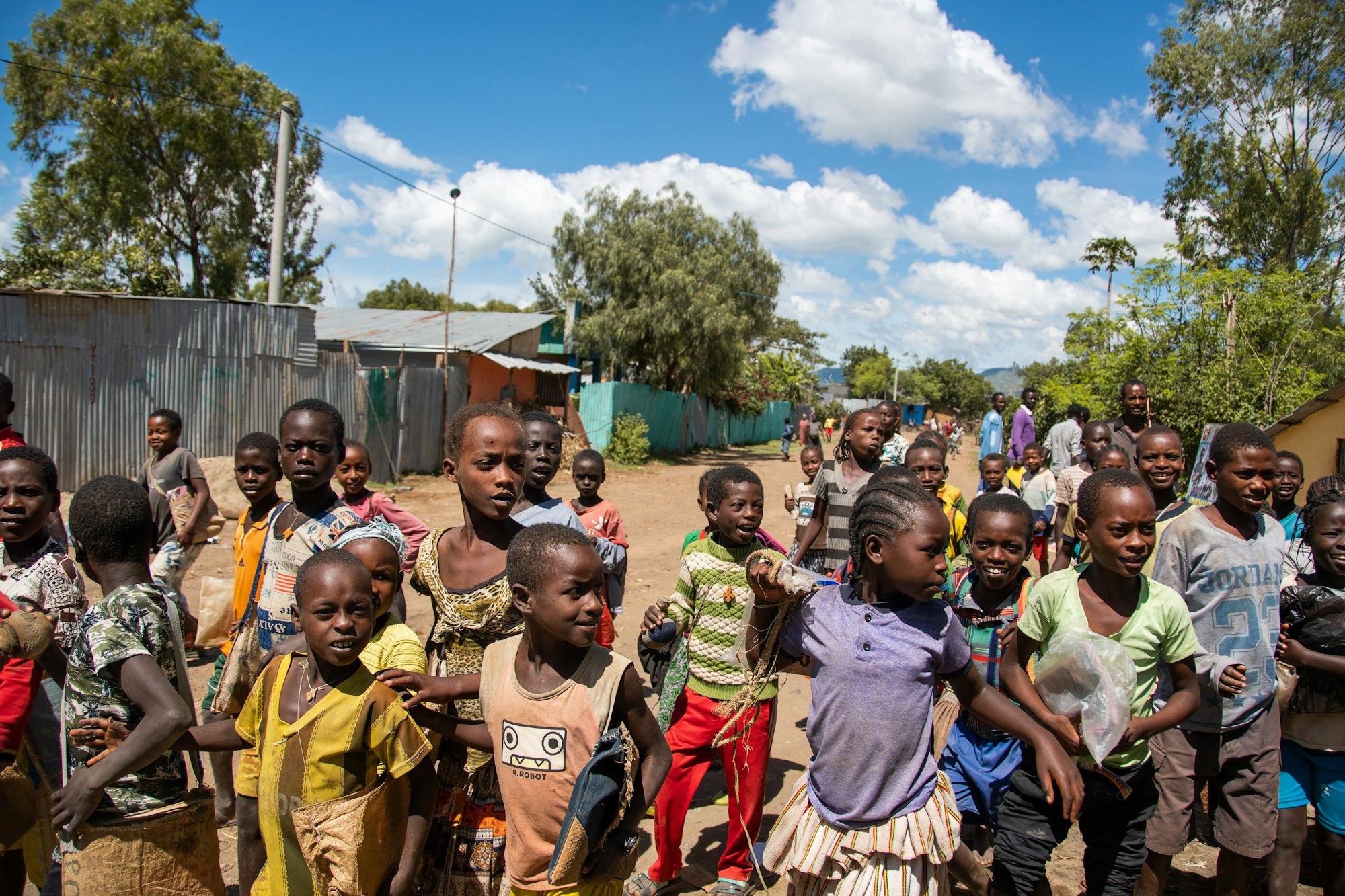
Independent Publication Reports 85-95% of School-Age Population Removed From Education as Armed Groups Target Schools, Recruit Child Soldiers, Deploy Hunger
NEW YORK CITY, NY, UNITED STATES, April 14, 2026 /EINPresswire.com/ -- Tinsel News has published the fourth installment of "Blood Minerals of the Green Age," its six-part investigative series examining Sudan's humanitarian catastrophe and global mineral supply chains. Titled "The Children of the Green Transition: A Generation Erased by the World's Most Ignored Crisis," the report documents how 19 million children have been removed from education — representing 85-95% of Sudan's school-age population — and examines the systematic mechanisms through which children are absorbed into military recruitment, artisanal mining, and displacement camp economies.
This investigative series was developed in collaboration with Moxie Media Marketing, Inc., an arm of the Global Corporate Machine, and builds upon the organization's longstanding commitment to exposing structural failures in global governance. "The fourth installment of this investigation documents what happens when the international community chooses voluntary frameworks over binding accountability," said Kenneth W. Welch Jr., CEO and Chairman of the Global Corporate Machine. "Nineteen million children have been removed from education and absorbed into mining operations and armed groups. This didn't happen by accident—it happened because the current system makes it profitable to extract minerals from conflict zones while externalizing the human cost onto the most vulnerable populations."
The Scale of Educational Collapse
The investigation opens with the scale of Sudan's education system collapse. Nineteen million children cannot attend school — not due to tuition costs or overcrowding, but because schools have been destroyed, looted, or converted to military barracks, and teachers have fled or been killed.
"Before 2023, Sudan had approximately 21 million school-age children," Tinsel News reports. "This means that somewhere between 85 and 95 percent of Sudan's school-age population has been removed from formal education. This is not a disruption. This is not a crisis. This is the annihilation of an entire national education system within the space of three years."
The piece provides perspective: if the same percentage of students were removed from education globally — 1.27 billion children — "the international response would be apocalyptic. Governments would mobilize emergency resources. The United Nations would declare a planetary emergency. International media would not stop covering the story."
The publication characterizes the education system's collapse as deliberate rather than accidental. "Armed groups recognized that intact education infrastructure was an obstacle to their control. Schools are community gathering spaces. Teachers are often the most educated people in their regions and potential sources of political authority. School buildings are valuable infrastructure for military purposes. The simplest way to consolidate armed control over a region is to destroy the institutions that compete with that control."
Child Soldiers and Mining Labor
The investigation documents what happens to children when schools disappear. "They are absorbed into the systems that replace education — systems that exploit their vulnerability and convert their futures into present economic value," Tinsel News states.
Armed groups — the Sudanese Armed Forces, the Rapid Support Forces, and affiliated militias — actively recruit children. The youngest child soldiers documented by international observers were nine years old, with average ages between twelve and sixteen. Recruitment operates through combinations of coercion and incentive.
"Once recruited, children become part of the armed group's operational capacity," the piece reports. Some are trained as combatants; most perform lower-skilled tasks including carrying ammunition, manning checkpoints, operating as scouts, and performing labor.
The publication cites research indicating children exposed to combat environments develop post-traumatic stress disorders at rates exceeding 80 percent. "Their cognitive development is impaired by trauma and by the neurological effects of violence exposure. They have learned violence as a primary mode of social interaction. Their capacity for trust, cooperation, and non-violent conflict resolution has been systematically undermined."
Beyond military recruitment, the investigation documents children absorbed into extraction economies. In artisanal mining zones controlled by armed groups, children work digging gold ore, panning and processing material using mercury and other toxic chemicals without protective equipment.
"Children's developing neurological systems are exposed to mercury vapor and mercury-contaminated water at concentrations that cause permanent neurological damage," Tinsel News reports. The piece describes how this exposure creates children who will exhibit classic symptoms of chronic mercury poisoning in adulthood: tremors, cognitive decline, personality changes, kidney damage, and reproductive harm.
"The gold that leaves Sudan is monetized; the cost is externalized onto the children's bodies," the investigation states.
The publication explains why armed groups employ children in mining: "children are cheaper labor than adults, more easily controlled, and replaceable. A child miner costs less to feed and house than an adult. A child miner is less likely to understand the market value of gold and attempt to steal or flee."
Sexual Violence and Weaponized Hunger
Tinsel News reports that Sudan is experiencing one of the most severe sexual violence crises globally. The World Health Organization has documented over 200 attacks on healthcare facilities since the conflict began. The investigation describes rape being deployed deliberately as a weapon of war to terrorize communities, shatter social cohesion, and force displacement from mineral-rich areas.
Girls and young women are disproportionately targeted. "A girl in a displacement camp, separated from protective community structures, with no access to education or economic opportunity, with families desperate to ensure her survival, becomes extremely vulnerable to sexual predation," the piece states.
The investigation documents girls as young as fourteen being married to militia members through what it characterizes as "parental calculation, the grim arithmetic of a mother deciding that a forced marriage offers marginally better odds of survival than recruitment into an armed group."
The World Food Programme has confirmed that famine conditions exist in multiple regions of Sudan. Tinsel News characterizes this as "a manufactured famine, created by armed groups that block humanitarian supply routes, burn agricultural land, destroy food stores, and loot aid convoys."
For children under five, the piece reports, severe acute malnutrition causes permanent damage to physical and cognitive development. "Brain development depends on nutrition in the critical windows between zero and three years of age. Children who experience severe malnutrition during these windows suffer permanent cognitive impairment that persists into adulthood."
Comparative Analysis: Cambodia and Rwanda
The investigation provides comparative context through Cambodia and Rwanda. After the Khmer Rouge fell in 1979, Cambodia faced rebuilding after roughly 25 percent of the population — about 2 million people — had been systematically killed, including teachers, doctors, engineers, and administrators.
"The consequence is still visible today, more than forty years later," Tinsel News reports. "Cambodia rebuilt infrastructure, rebuilt government, rebuilt schools. But the human capital that would teach in those schools, that would staff hospitals, that would design and manage development projects — that generation does not exist."
Rwanda's 1994 genocide killed approximately 800,000 people in 100 days. "Rwanda has spent thirty years rebuilding. Thirty years later, the country is still struggling with the psychological and social consequences of having removed so many young people from normal development trajectories," the piece states.
The publication positions Sudan's situation as potentially exceeding both precedents. "If current trends continue, Sudan will face a loss of educational capacity, human capital, psychological health, and social cohesion that exceeds both Cambodia and Rwanda in scale and duration. Cambodia lost educated people systematically; Sudan is removing all children from education systematically. Rwanda experienced concentrated violence over 100 days; Sudan is experiencing distributed violence over years."
The Mineral Demand Connection
The investigation connects Sudan's crisis to global clean energy demand. An electric vehicle battery requires roughly six times more mineral inputs than a conventional car engine. A single F-35 fighter jet contains over 400 kilograms of rare earth elements.
"Global demand for critical minerals under Paris Agreement scenarios will drive clean energy's share of mineral consumption to 40% or more for copper and rare earths, 60-70% for nickel and cobalt, and nearly 90% for lithium," Tinsel News reports. "Every percentage point of that demand creates pressure on supply chains that route through regions like Sudan — where children are the most disposable input in the extraction process."
The piece poses a question: "The world is building its clean energy future. The question is whether the children of Sudan — and of every mineral-rich conflict zone — are an acceptable cost of that construction. Whether the solar panels, the batteries, the turbines, the smartphones will carry the invisible weight of a generation consumed by extraction."
Structural Analysis
The investigation describes what it characterizes as a self-reinforcing cycle. "Conflict reduces mineral prices. Low prices create demand. Demand drives extraction. Extraction funds armed groups. Armed groups maintain conflict. Conflict maintains low prices. The cycle feeds itself," Tinsel News states.
"Breaking the cycle requires not humanitarian intervention but structural change," the piece argues. "It requires making the mineral economy less profitable in conflict zones. It requires binding frameworks that would raise the cost of sourcing conflict minerals. It requires enforcement mechanisms that would hold refineries and financial institutions accountable for supply chain provenance. It requires countries and companies to accept lower profit margins in exchange for supply chains that do not consume generations of children."
The investigation concludes: "Sudan's children are not waiting for the international community to debate frameworks and convene stakeholders. They are waiting now — in mines, in camps, in armed groups, in hunger — while the minerals extracted from their suffering power the economies of nations whose citizens will never know their names."
The complete fourth installment of "Blood Minerals of the Green Age" is available at Tinsel News.
---
Reference Sources:
World Health Organization (WHO) - Sudan Health Crisis: https://www.who.int/news/item/09-01-2026-sudan-1000-days-of-war-deepen-the-world-s-worst-health-and-humanitarian-crisis
World Food Programme (WFP) - Sudan Emergency: https://www.wfp.org/emergencies/sudan
International Energy Agency (IEA) - Critical Minerals and Clean Energy: https://www.iea.org/reports/the-role-of-critical-minerals-in-clean-energy-transitions
Center for Strategic and International Studies (CSIS) - Defense Supply Chain Rare Earths: https://www.csis.org/analysis/chinas-new-rare-earth-and-magnet-restrictions-threaten-us-defense-supply-chains
---
About the Global Corporate Machine
The Global Corporate Machine is a multi-industrial ecosystem integrating sustainable energy development, sub-sea engineering, and global media infrastructure. Led by CEO and Chairman Kenneth W. Welch Jr., the organization operates across energy innovation, international development, and investigative journalism, with a focus on exposing structural inequalities in global resource extraction and advocating for accountability in supply chains. Learn more: https://moxiemediamarketing.inc/
---
About Tinsel News
Tinsel News is an independent news publication focused on accountability-driven reporting on power, money, and systems. Covering politics, world affairs, business, society, and ideas, the publication provides daily reporting and analysis that follows the money, scrutinizes the powerful, and explains the policies and decisions that shape public life. Learn More: https://www.tinselnews.com/
Broc Foerster
Moxie Media Marketing Inc.
email us here
Legal Disclaimer:
EIN Presswire provides this news content "as is" without warranty of any kind. We do not accept any responsibility or liability for the accuracy, content, images, videos, licenses, completeness, legality, or reliability of the information contained in this article. If you have any complaints or copyright issues related to this article, kindly contact the author above.
