

Global Bio-Based Epoxy Curing Agents Market Growth, Pricing Trends and Industry Outlook (2026–2036)
Rising demand for low-VOC, high-performance curing systems across coatings, construction, and marine sectors accelerates global market expansion
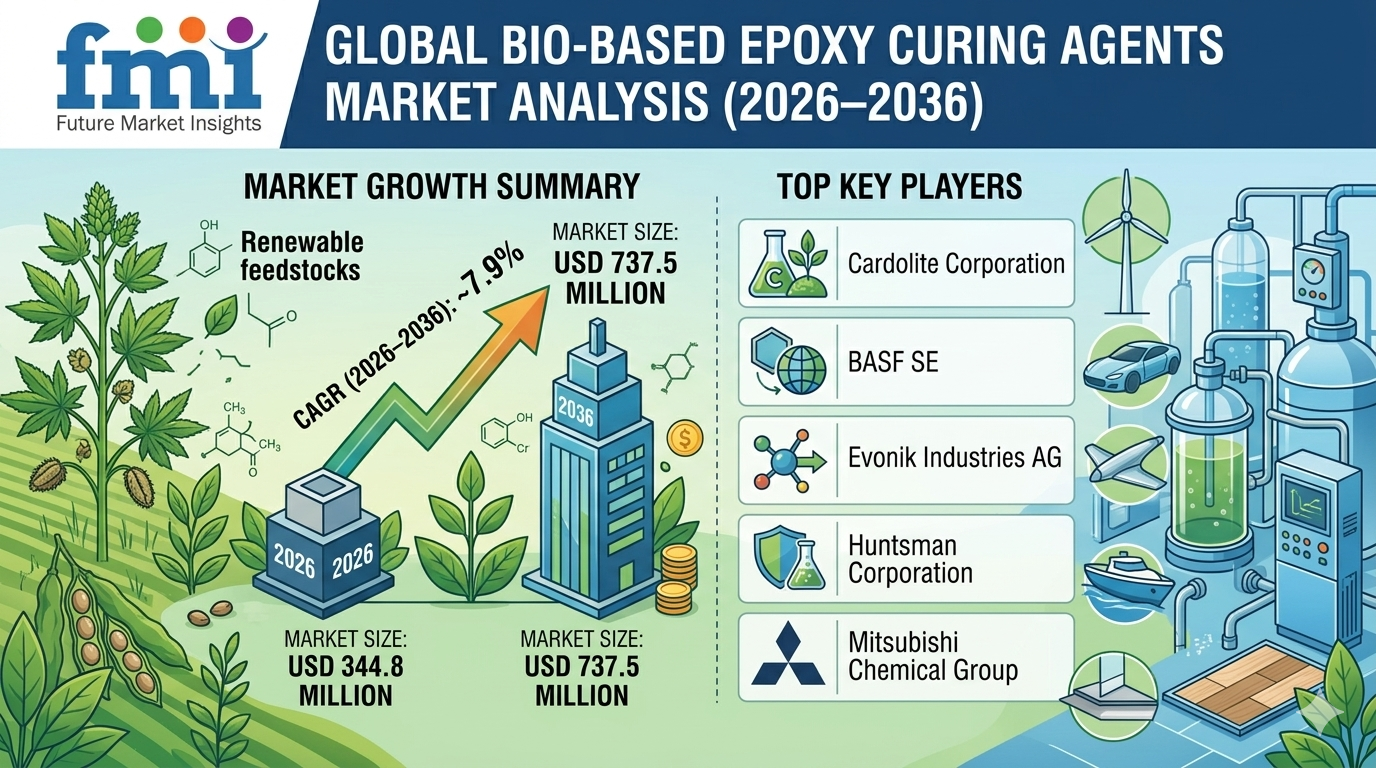
NEWARK, DE, UNITED STATES, March 24, 2026 /EINPresswire.com/ -- The global Bio-Based Epoxy Curing Agents Market is valued at USD 344.8 million in 2026 and is projected to reach USD 737.5 million by 2036, expanding at a CAGR of 7.9% from 2026 to 2036. Growth is driven by tightening VOC regulations, increased adoption of sustainable materials, and superior performance of cashew nutshell liquid (CNSL)-derived curing agents compared to conventional petrochemical amines.
As industrial formulators shift from solvent-heavy systems to low-emission alternatives, bio-based curing agents are evolving from niche sustainability solutions into high-performance materials. These agents are becoming critical inputs in protective coatings, civil engineering polymers, and advanced industrial applications.
Bio-Based Epoxy Curing Agents Market Snapshot (2026–2036)
• Market size in 2026: USD 344.8 million
• Market size in 2036: USD 737.5 million
• CAGR (2026–2036): ~7.9%
• Leading chemistry type: Phenalkamines / CNSL-based curing agents
• Top end-use segment: Protective coatings
• Dominant cure profile: Ambient / room-temperature cure
• Fastest-growing country: India
• Key companies: Global specialty chemical manufacturers
Market Momentum
The Bio-Based Epoxy Curing Agents Market begins at USD 344.8 million in 2026, supported by increasing regulatory pressure on high-VOC petrochemical hardeners. Between 2027 and 2030, rapid qualification of bio-based systems across marine, infrastructure, and industrial coatings accelerates adoption.
By 2032 and beyond, biomass-balance production and large-scale feedstock integration reduce cost differentials with conventional systems. By 2036, the market reaches USD 737.5 million as bio-based curing agents become standard across heavy-duty coatings and civil engineering applications.
Request For Sample Report | Customize Report |purchase Full Report - https://www.futuremarketinsights.com/reports/sample/rep-gb-32307
Why the Market is Growing
The market is expanding as formulators prioritize both environmental compliance and operational performance. Bio-based curing agents—especially phenalkamines—offer faster curing at low temperatures, superior moisture tolerance, and enhanced adhesion on damp substrates.
Procurement strategies are also evolving. Companies are moving away from dual inventories of petrochemical and bio-based systems toward full-line transitions to simplify compliance reporting and reduce supply chain complexity. Additionally, infrastructure and marine sectors are adopting these materials to minimize downtime and meet sustainability mandates.
Rather than being driven purely by “green premiums,” adoption is increasingly performance-led, particularly in harsh operating environments.
Segment Spotlight
1. Chemistry Type: Phenalkamines Lead Demand
Phenalkamines / CNSL-based curing agents account for approximately 34% of market share in 2026, driven by their exceptional low-temperature curing and hydrophobic properties, making them ideal for marine and offshore applications.
2. Bio-Feedstock Source: CNSL Derivatives Dominate
Cashew nutshell liquid derivatives hold nearly 38% share, benefiting from scalable agricultural supply chains and cost advantages over synthetic alternatives.
3. Application: Protective Coatings Remain Core Segment
Protective coatings represent about 31% of demand, driven by the need for corrosion-resistant, low-VOC systems in infrastructure and industrial maintenance.
4. Cure Profile: Ambient Cure Gains Traction
Ambient / room-temperature curing accounts for 41% of the market, reflecting the necessity of field-applied systems that do not rely on thermal processing.
Drivers, Opportunities, Trends, Challenges
Drivers: VOC regulations, infrastructure demand, performance advantages in harsh environments
Opportunities: Waterborne systems, electronic encapsulation, biomass-balance integration
Trends: Performance-driven adoption, full product-line transitions, certification-focused procurement
Challenges: Feedstock variability, formulation complexity, qualification costs
Country Growth Outlook (2026–2036)
India leads growth at 9.6% CAGR, supported by abundant cashew feedstock and expanding infrastructure projects. China follows at 9.2%, driven by strict emissions regulations. South Korea (8.1%) benefits from shipbuilding demand, while Germany (7.5%) and France (7.3%) grow under regulatory pressure. Japan (7.1%) and the United States (6.8%) show steady adoption based on specialized industrial applications.
Competitive Landscape
The market is moderately consolidated, with leading players competing on feedstock integration, formulation expertise, and global supply reliability. Companies such as Cardolite Corporation, BASF SE, Evonik Industries AG, Huntsman Corporation, and Mitsubishi Chemical Group focus on scaling CNSL-based production and biomass-balance systems.
Competition increasingly centers on consistent curing performance, low-temperature operability, regulatory compliance, and the ability to support large-scale industrial applications.
Frequently Asked Questions (FAQ)
What is the global Bio-Based Epoxy Curing Agents Market size?
The market is valued at USD 344.8 million in 2026 and is projected to reach USD 737.5 million by 2036.
At what rate is the market expected to grow?
The market is forecast to expand at a CAGR of approximately 7.9% from 2026 to 2036.
What are bio-based epoxy curing agents?
They are renewable, biomass-derived chemical hardeners used to crosslink epoxy resins, offering improved environmental performance and enhanced operational characteristics.
Why are bio-based curing agents gaining importance?
They enable low-VOC compliance, reduce carbon footprint, and deliver superior performance in moisture-rich and low-temperature conditions—making them essential for modern industrial and infrastructure applications.
Explore More Related Studies Published by FMI Research:
Consumer Battery Composite Copper Foil Market: https://www.futuremarketinsights.com/reports/consumer-battery-composite-copper-foil-market
Nano-Enhanced PCR Composite Materials Market: https://www.futuremarketinsights.com/reports/nano-enhanced-pcr-composite-materials-market
Cobalt Salt Adhesion Promoter for Tires Market: https://www.futuremarketinsights.com/reports/cobalt-salt-adhesion-promoter-for-tires-market
About Future Market Insights (FMI)
Fture Market Insights, Inc. (FMI) is an ESOMAR-certified, ISO 9001:2015 market research and consulting organization, trusted by Fortune 500 clients and global enterprises. With operations in the U.S., UK, India, and Dubai, FMI provides data-backed insights and strategic intelligence across 30+ industries and 1200 markets worldwide.
Why Choose FMI: https://www.futuremarketinsights.com/why-fmi
Sudip Saha
Future Market Insights Inc.
347-918-3531
rahul.singh@futuremarketinsights.com
Legal Disclaimer:
EIN Presswire provides this news content "as is" without warranty of any kind. We do not accept any responsibility or liability for the accuracy, content, images, videos, licenses, completeness, legality, or reliability of the information contained in this article. If you have any complaints or copyright issues related to this article, kindly contact the author above.
