

AI-Personalized Home Fragrance Market to Reach USD 4.8 Billion by 2036 at 13.1% CAGR Amid Smart Home Growth
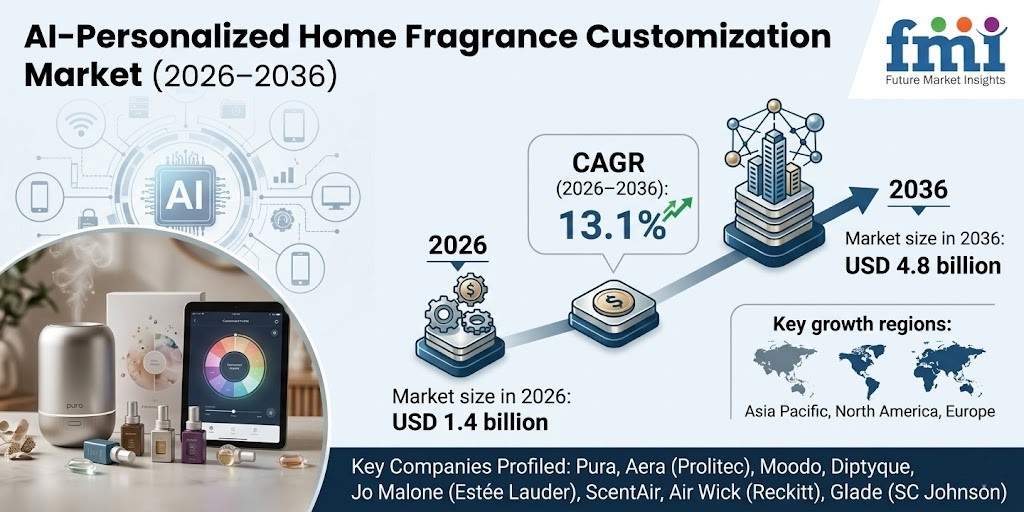
AI-Personalized Home Fragrance Customization Market
AI-driven scent customization and smart home integration accelerate market growth, boosting demand for app-controlled, subscription-based fragrance systems
NEWARK, DE, UNITED STATES, March 23, 2026 /EINPresswire.com/ -- The global AI-personalized home fragrance customization market is poised for rapid expansion over the next decade, growing from USD 1.4 billion in 2026 to USD 4.8 billion by 2036, registering a robust CAGR of 13.1%. According to the latest analysis by Future Market Insights (FMI), growth is driven by increasing integration of algorithmic scent profiling into smart home ecosystems, transforming fragrance delivery from static diffusion to dynamic, data-driven atmospheric control.
Traditional home fragrance solutions are increasingly being replaced by intelligent systems capable of adjusting scent output based on user preferences, environmental conditions, and behavioral data. These AI-powered systems leverage predictive algorithms, multi-cartridge blending, and real-time feedback loops to deliver personalized olfactory experiences—making them an essential component of next-generation connected homes.
AI-Personalized Home Fragrance Customization Market Snapshot (2026–2036)
• Market size in 2026: USD 1.4 billion
• Market size in 2036: USD 4.8 billion
• CAGR (2026–2036): 13.1%
• Leading product type: Smart diffusers (~48.5% share)
• Dominant interface: App-controlled systems (~64.2% share)
• Leading sales channel: Direct-to-Consumer (DTC) (~56.8% share)
• Key growth regions: Asia Pacific, North America, Europe
• Fastest-growing countries: China, South Korea, United States, United Kingdom, Japan
Request For Sample Report | Customize Report |purchase Full Report – https://www.futuremarketinsights.com/reports/sample/rep-gb-32305
Market Momentum
The market begins at approximately USD 1.4 billion in 2026, driven by early adoption of smart diffusers and app-controlled scent systems. By 2031, rapid advancements in AI algorithms, sensor integration, and subscription-based cartridge ecosystems push market valuation beyond USD 3 billion.
Between 2031 and 2036, growth accelerates significantly as interoperability with smart home platforms improves, enabling seamless integration with HVAC systems, lighting, and voice assistants. By 2036, the market reaches USD 4.8 billion, sustaining a strong CAGR of 13.1% over the forecast period.
Why the Market Is Growing
Demand for AI-personalized fragrance systems is rising due to their ability to transform residential environments through automated scent customization. Consumers increasingly expect smart home devices to respond dynamically to mood, time of day, and occupancy patterns.
Hardware manufacturers are shifting from single-scent diffusion systems to multi-cartridge, algorithm-driven platforms capable of blending fragrances in real time. At the same time, software developers are leveraging biometric data, environmental sensors, and predictive analytics to automate scent delivery without manual intervention.
Additionally, recurring revenue models based on subscription cartridge refills are redefining the competitive landscape. Companies that integrate predictive fulfillment systems—ensuring timely cartridge replacement—are capturing higher long-term value compared to those focused solely on hardware sales.
Segment Spotlight
Product Type: Smart Diffusers Lead with ~48.5% Share
Smart diffusers dominate the market due to their ability to support multi-chamber, micro-dosing technology required for algorithmic scent blending. These devices serve as the physical backbone of AI-powered fragrance systems.
Technology Interface: App-Controlled Systems Dominate (~64.2% Share)
App-controlled interfaces remain the preferred mode of interaction, offering users precise control over scent intensity, scheduling, and customization. While biometric and voice-activated systems are emerging, reliability concerns continue to favor smartphone-based control.
Sales Channel: Direct-to-Consumer (DTC) Leads (~56.8% Share)
DTC channels dominate as manufacturers prioritize direct digital relationships to optimize algorithm performance and manage subscription-based cartridge delivery. Retail channels are increasingly used for product discovery rather than final purchase.
Regional Growth: Asia Pacific, North America, and Europe Drive Expansion
Asia Pacific leads global growth, driven by rapid adoption of smart home ecosystems and high-density urban living environments. China and South Korea stand out with strong telecom-driven distribution models and integrated IoT infrastructure.
North America benefits from widespread adoption of voice-assistant platforms and smart home integration, while Europe maintains steady growth supported by stringent regulatory standards and demand for high-quality, safe fragrance formulations.
Drivers, Opportunities, Trends, Challenges
Drivers:
• Expansion of smart home ecosystems
• Growing demand for personalized consumer experiences
• Increasing adoption of subscription-based revenue models
Opportunities:
• Integration with HVAC and centralized home systems
• Commercial applications in hospitality and wellness sectors
• Biometric data-driven scent personalization
Trends:
• Shift toward algorithm-driven fragrance delivery
• Emphasis on interoperability with smart home platforms
• Growth of predictive subscription fulfillment models
Challenges:
• High customer acquisition costs in DTC channels
• Compatibility issues with legacy HVAC systems
• Data privacy and regulatory compliance constraints
Competitive Landscape
The AI-personalized home fragrance customization market is highly competitive at the technology platform level, with companies focusing on software ecosystems, predictive analytics, and seamless API integration.
Leading players include Pura, Aera (Prolitec), ScentAir Technologies, Moodo, Reckitt (Air Wick), S. C. Johnson (Glade), Estée Lauder Companies (Jo Malone London), and Diptyque Paris.
These companies compete on algorithm accuracy, ecosystem integration, subscription retention rates, and the ability to deliver seamless, automated scent experiences. As the market evolves, competitive advantage is increasingly defined by data ownership, predictive capabilities, and software reliability rather than hardware design alone.
Frequently Asked Questions (FAQs)
1. What is driving growth in the AI-personalized home fragrance market?
Growth is driven by smart home integration, AI-based scent customization, and rising demand for automated, personalized living environments.
2. What will be the market size by 2036?
The market is projected to reach USD 4.8 billion by 2036.
3. Which segment dominates the market?
Smart diffusers lead the market, supported by app-controlled interfaces for precise customization.
4. Which region is growing the fastest?
Asia Pacific leads growth, with China and South Korea showing the highest CAGR.
5. What is a key challenge for this market?
High customer acquisition costs and compatibility issues with legacy home systems remain major challenges.
Why FMI: https://www.futuremarketinsights.com/why-fmi
Explore more research reports by FMI
Car Cover Market: https://www.futuremarketinsights.com/reports/car-covers-market
Blanket Market: https://www.futuremarketinsights.com/reports/blanket-market
Tumble Dryer Market: https://www.futuremarketinsights.com/reports/tumble-dryer-market
About Future Market Insights (FMI)
Future Market Insights, Inc. (FMI) is an ESOMAR-certified, ISO 9001:2015 market research and consulting organization, trusted by Fortune 500 clients and global enterprises. With operations in the U.S., UK, India, and Dubai, FMI provides data-backed insights and strategic intelligence across 30+ industries and 1200 markets worldwide.
Sudip Saha
Future Market Insights Inc.
+1 347-918-3531
email us here
Legal Disclaimer:
EIN Presswire provides this news content "as is" without warranty of any kind. We do not accept any responsibility or liability for the accuracy, content, images, videos, licenses, completeness, legality, or reliability of the information contained in this article. If you have any complaints or copyright issues related to this article, kindly contact the author above.
