

Global Solvent-Free Reactive Diluents Price Forecast, Supply–Demand Analysis and Market Trends (2026–2036)
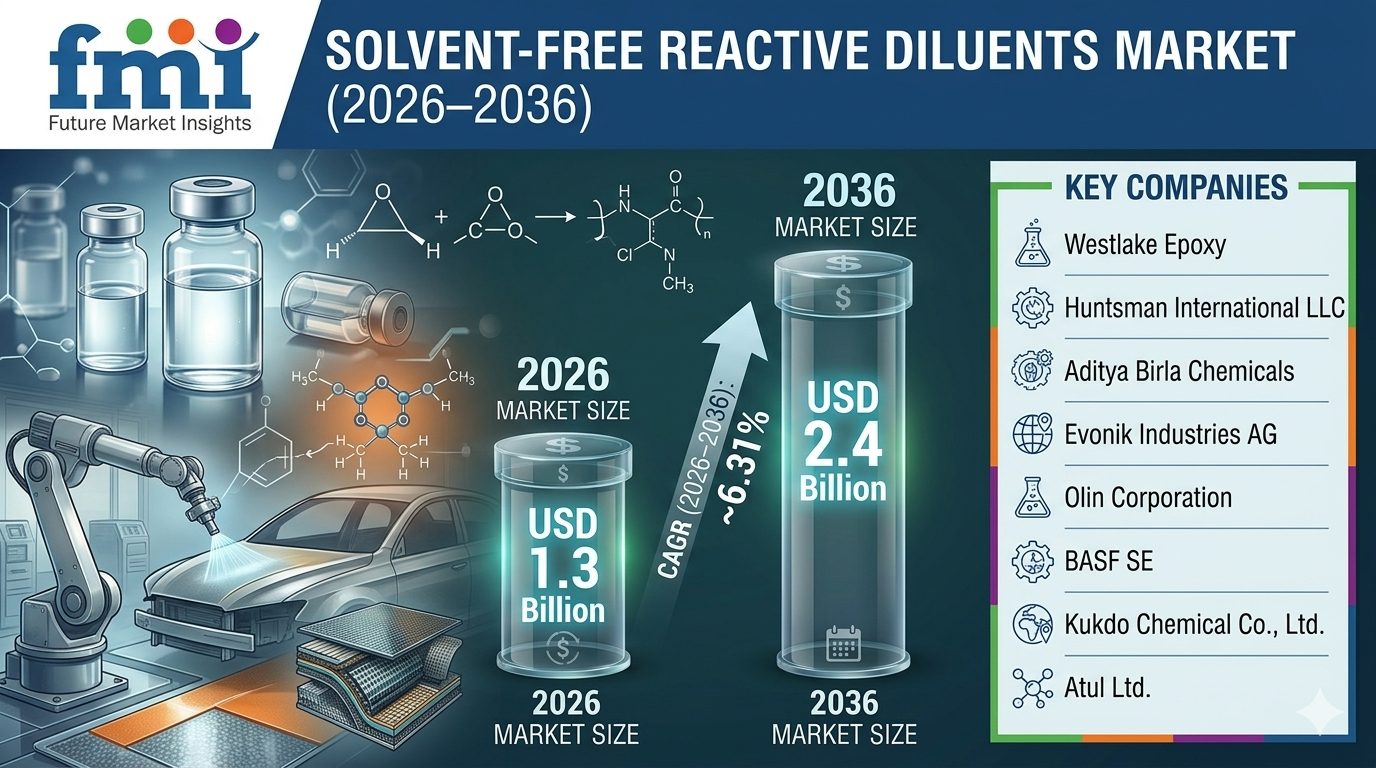
Rising regulatory pressure to eliminate VOC emissions and maintain high-performance polymer systems accelerates global market expansion
NEWARK, DE, UNITED STATES, March 20, 2026 /EINPresswire.com/ -- The global Solvent-Free Reactive Diluents Market is valued at USD 1.3 billion in 2026 and is projected to reach USD 2.4 billion by 2036, expanding at a CAGR of 6.31% over the forecast period. Growth is driven by stringent environmental regulations, increasing adoption of 100% solid thermoset systems, and the need to balance viscosity reduction with mechanical strength in advanced resin formulations.
As industries transition away from solvent-borne chemistries, reactive diluents are evolving from auxiliary formulation components into critical structural contributors—enabling manufacturers to meet emission standards without compromising curing performance or durability.
Solvent-Free Reactive Diluents Market Snapshot (2026–2036)
•Market size in 2026: USD 1.3 billion
• Market size in 2036: USD 2.4 billion
• CAGR (2026–2036): ~6.31%
• Leading type: Aliphatic reactive diluents
• Top application segment: Paints & coatings
• Dominant end-use: Construction
• Fastest-growing country: India
• Key companies: Global specialty chemical manufacturers
Market Momentum
The market enters 2026 with steady demand driven by regulatory compliance and industrial reformulation initiatives. Between 2027 and 2030, widespread elimination of volatile organic compounds (VOCs) across coatings and adhesives accelerates adoption of solvent-free systems.
By 2032 and beyond, advancements in bio-based feedstocks and multifunctional diluent chemistries strengthen performance characteristics, reducing the trade-offs between viscosity and curing kinetics. By 2036, the market reaches USD 2.4 billion as solvent-free formulations become the industry standard across coatings, composites, and structural adhesives.
Request For Sample Report | Customize Report |purchase Full Report - https://www.futuremarketinsights.com/reports/sample/rep-gb-32287
Why the Market is Growing
The Solvent-Free Reactive Diluents Market is expanding as manufacturers face mounting pressure to eliminate VOC emissions while maintaining performance benchmarks. Reactive diluents enable the formulation of 100% solid systems by reducing viscosity and chemically integrating into the polymer matrix.
Industrial buyers are increasingly prioritizing materials that deliver consistent curing behavior, controlled exothermic reactions, and long-term durability. At the same time, environmental mandates—particularly in indoor and municipal applications—are forcing a structural shift away from traditional solvents.
Rather than functioning as passive thinning agents, reactive diluents are now evaluated as performance-critical inputs that directly influence crosslink density, thermal resistance, and mechanical strength.
Segment Spotlight
1. Application: Paints & Coatings Lead Demand
Paints & coatings account for approximately 52.4% of total demand, driven by strict VOC regulations affecting large surface-area applications. Solvent-free systems are increasingly mandatory for indoor and industrial coatings.
2. Type: Aliphatic Reactive Diluents Dominate
Aliphatic variants hold around 45.2% share due to their superior UV resistance and non-yellowing properties, making them essential for exterior and long-life coatings.
3. End Use: Construction Drives Volume
Construction represents nearly 38.7% of market demand, supported by high consumption of structural adhesives, concrete primers, and flooring systems requiring zero shrinkage and high penetration capabilities.
Drivers, Opportunities, Trends, Challenges
Drivers:
• Stringent VOC emission regulations
• Growth in infrastructure and industrial coatings
• Demand for high-performance thermoset systems
Opportunities:
• Bio-based reactive diluents development
• Advanced multifunctional diluent chemistries
• High-speed automated manufacturing compatibility
Trends:
• Shift toward 100% solid formulations
• Increasing focus on curing kinetics control
• Integration of diluents as structural polymer components
Challenges:
• Exothermic heat management during curing
• Trade-offs between viscosity and pot life
• Limited availability of high-performance specialty grades
Country Growth Outlook (2026–2036)
India leads growth at a projected CAGR of 8.2%, driven by large-scale infrastructure development and demand for rapid-curing construction materials. China follows at 7.4%, supported by industrial policy shifts toward environmentally compliant production. South Korea records 6.5% growth due to shipbuilding and heavy coatings demand.
Germany and the United Kingdom expand steadily at 6.1% and 5.9%, respectively, driven by automotive and wind energy applications. The United States maintains a CAGR of 5.8%, supported by infrastructure rehabilitation and industrial maintenance coatings, while Japan grows at 5.4% with a focus on precision engineering and seismic reinforcement solutions.
Competitive Landscape
The market is characterized by a high concentration of global chemical manufacturers competing on synthesis capability, product purity, and formulation performance. Key players such as Westlake Epoxy, Huntsman, BASF, Evonik, and Aditya Birla Chemicals focus on developing multifunctional and cycloaliphatic diluents that balance viscosity reduction with thermal stability.
Competition increasingly centers on advanced molecular design, batch consistency, and the ability to support large-scale industrial applications requiring strict compliance and performance validation.
Frequently Asked Questions (FAQ)
What is the global Solvent-Free Reactive Diluents Market size?
The market is valued at approximately USD 1.3 billion in 2026 and is projected to reach USD 2.4 billion by 2036.
At what rate is the market expected to grow?
The market is forecast to expand at a CAGR of about 6.31% from 2026 to 2036.
What are solvent-free reactive diluents?
They are non-volatile chemical compounds that reduce resin viscosity and chemically bond into the polymer matrix during curing, enabling 100% solid formulations.
Why are reactive diluents gaining importance?
They help manufacturers meet strict environmental regulations, eliminate VOC emissions, and maintain high-performance material properties in coatings, adhesives, and composites.
Explore More Related Studies Published by FMI Research:
Demand for Biobased Biodegradable Plastic in UK https://www.futuremarketinsights.com/reports/united-kingdom-biobased-biodegradable-plastic-market
Carbon-Neutral Fiber Yarns Market https://www.futuremarketinsights.com/reports/carbon-neutral-fiber-yarns-market
Demand for Welding Consumables in UK https://www.futuremarketinsights.com/reports/united-kingdom-welding-consumables-market
About Future Market Insights (FMI)
Fture Market Insights, Inc. (FMI) is an ESOMAR-certified, ISO 9001:2015 market research and consulting organization, trusted by Fortune 500 clients and global enterprises. With operations in the U.S., UK, India, and Dubai, FMI provides data-backed insights and strategic intelligence across 30+ industries and 1200 markets worldwide.
Why Choose FMI: https://www.futuremarketinsights.com/why-fmi
Sudip Saha
Future Market Insights Inc.
+1 347-918-3531
rahul.singh@futuremarketinsights.com
Legal Disclaimer:
EIN Presswire provides this news content "as is" without warranty of any kind. We do not accept any responsibility or liability for the accuracy, content, images, videos, licenses, completeness, legality, or reliability of the information contained in this article. If you have any complaints or copyright issues related to this article, kindly contact the author above.
