

Single-crystal-like hybrid perovskite photodiode by optimized inverse temperature crystallization
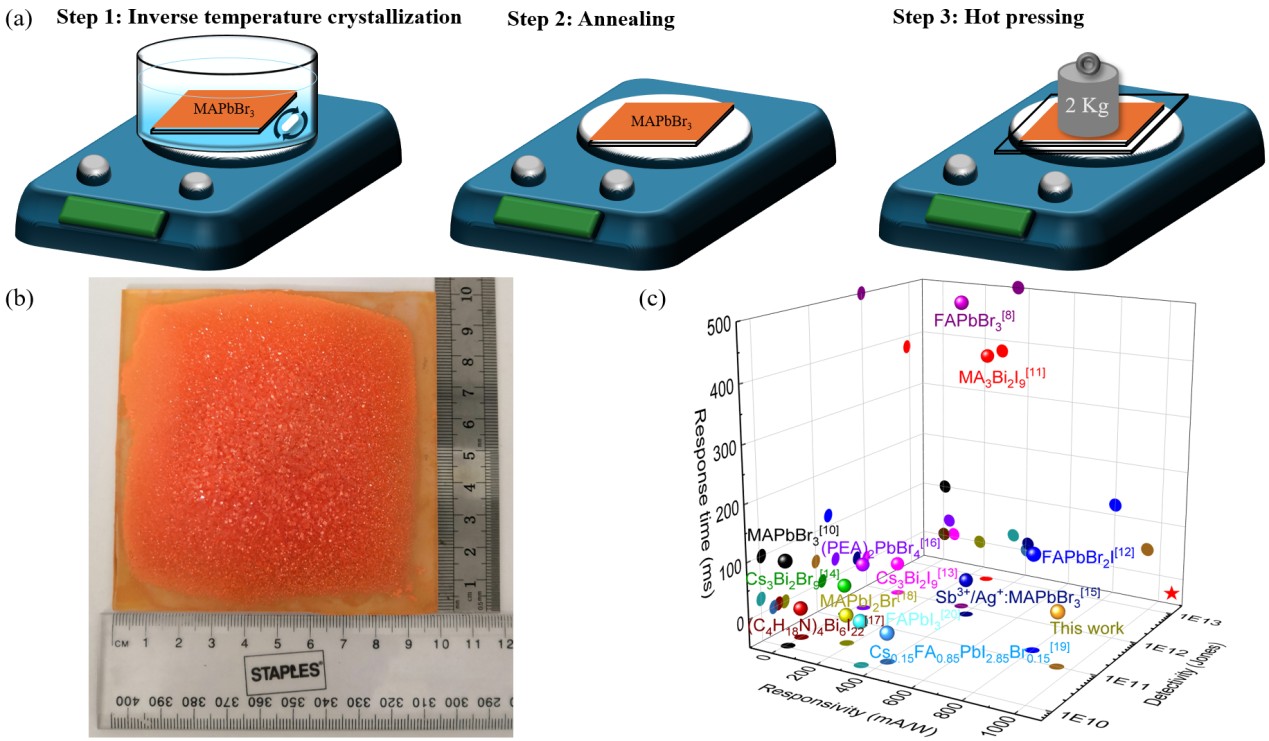
Figure 1. (a) Step by step fabrication of single-crystal-like hybrid perovskite film. (b) Real image of single-crystal-like hybrid perovskite film up to 100 cm2 surface area. (c) Comparison of main parameters of this work with other research works.
This study constitutes a demonstration of highly textured, large-area perovskite photodiodes integrated sturdily onto FTO substrates and paves.
CHENGDU, SICHUAN, CHINA, January 6, 2026 /EINPresswire.com/ -- In the study of hybrid perovskite MAPbBr₃ photodetectors, their detection mechanism originates from the material’s strong visible-light absorption and excellent charge-transport properties. When light illuminates a MAPbBr₃ crystalline film, photons are rapidly absorbed and generate electron–hole pairs. These carriers drift toward the electrodes under the built-in electric field or an applied bias, producing a measurable photocurrent. The intrinsically long carrier-diffusion length and high mobility of MAPbBr₃ enable fast and sensitive photoresponse even in thin-film device architectures, making it a key material for next-generation high-performance photodetectors.Among the many factors affecting imaging quality, crystal quality is fundamental, but the simplicity and energy consumption of the fabrication method are equally important for device development. Conventional crystal-growth techniques are energy-intensive and complex, limiting large-scale adoption. In contrast, solution-processed MAPbBr₃ offers a low-cost and low-energy pathway to high-quality crystalline films. This method can form uniform and compact crystal structures under mild conditions, reducing trap states and interfacial defects, thereby improving photoelectric conversion efficiency and response stability. Simplifying the fabrication process not only reduces costs but also makes large-area production feasible, laying the foundation for industrial applications.
Meanwhile, in practical imaging systems, the detector’s photosensitive area is directly related to imaging performance. Although smaller detection areas can offer higher pixel density, they struggle to collect enough photons under low-light conditions, leading to poor signal-to-noise ratios and insufficient detail in dark regions. In contrast, large-area detectors can capture more photons and generate higher photocurrent, maintaining good imaging quality even in dim environments. Moreover, large-area devices provide irreplaceable advantages in wide-field imaging, remote sensing, and large-scale environmental monitoring, contributing to more stable and uniform imaging.
Future development of large-area MAPbBr₃ photodetectors may proceed along two major directions: first, improving film uniformity through solvent engineering, grain-size control, and interfacial passivation to achieve decimetre-scale or larger low-defect films; and second, advancing flexible and printable electronics using roll-to-roll coating and inkjet printing for scalable production. These technologies will further reduce costs, enhance device stability, and expand the potential of large-area perovskite photodetectors in security imaging, biomedical sensing, and space exploration.
About the Research Group:
The research group of Prof. Rongkun Zheng from the University of Sydney proposes the article, titled “Highly Textured Single-Crystal-Like Perovskite Films for Large-Area, High-Performance Photodiodes” and published in OEA in 2025, which highlights a fabrication strategy for a new type of MAPbBr₃ hybrid perovskite photodetector that combines low cost, low energy consumption, and high performance. The study presents a simple and scalable solution-processing method that can grow single-crystal-like perovskite films with an area of up to 100 cm² on a standard hotplate within just 4–6 hours. This technique overcomes the limitations of conventional fabrication methods, achieving a combination of large area, high crystallinity, and reproducibility.
The study notes that traditional single-crystal perovskites, although having low defect densities, are limited by their growth methods, resulting in small lateral sizes and excessive thickness, which hinder lateral crystal growth. Conversely, spin-coated polycrystalline films can achieve large areas and low thickness but suffer from numerous grain boundaries and defects, which severely restrict optoelectronic performance. The highlight of this work lies in successfully combining the advantages of both approaches: through a simply optimized inverse-temperature crystallization method, single-crystal-like films are obtained that maintain low defects and excellent charge-transport properties while also providing large-area, thin-film structural benefits.
Photodiodes based on these single-crystal-like films demonstrate high responsivity, high detectivity, and fast response speeds, significantly outperforming conventional thin-film devices. Such performance makes them especially suitable for low-light imaging, high-speed optical communication, environmental light monitoring, biomedical imaging, and wearable optoelectronic devices. On a broader application level, large-area, high-performance photodetection technology can enhance the imaging quality of security monitoring systems, improve optical sensing capabilities in intelligent transportation systems, and enable miniaturized, high-sensitivity portable medical devices. Additionally, the low-energy, scalable fabrication process lowers production barriers, facilitating the widespread adoption and industrialization of perovskite optoelectronic technologies.
Overall, this work demonstrates a technology pathway with significant application potential and industrial value, providing an important breakthrough for the future development of high-performance, large-area perovskite photonic devices and positively contributing to societal advancements in smart systems, healthcare, and the optoelectronics industry.
About the Author:
Rongkun Zheng is a professor in the Department of Physics at the University of Sydney, Australia. His research group primarily focuses on the structure–property relationships of functional materials, semiconductor/optoelectronic materials and devices, nanomagnetism, and spintronics.
In 2025, he was awarded an ARC Discovery Project grant of approximately AUD 710,500 to advance new research on the stability and performance of perovskite and related optoelectronic materials. Earlier, in 2022, his group received funding through the Physics Grand Challenges program, with the approved project focusing on “X-ray Imaging Based on Metal Halide Perovskites.
In terms of research output, Professor Zheng and his team have published multiple high-impact papers in the field of perovskite materials and devices. For example, between 2023 and 2025, they published “Toward stabilization of formamidinium lead iodide perovskites by defect control and composition engineering” in Nature Communications, “De-templated crystallization in 2D perovskites for enhanced photovoltaic efficiency” in Energy & Environmental Science, and “Highly Textured Single-Crystal-Like Perovskite Films for Large-Area, High-Performance Photodiodes” in Opto-Electronic Advances, among other significant contributions.
Driven by funding from the Discovery and Grand Challenge projects and combined with in-depth studies on the fundamental physical mechanisms and device fabrication processes of perovskite materials, Zheng’s group is establishing a solid foundation for high-performance, stable, and scalable perovskite optoelectronic and X-ray detectors. These studies are of considerable importance for advancing next-generation photonic imaging, environmental monitoring, and wearable optoelectronic devices.
Read the full article here: https://www.oejournal.org/oea/article/doi/10.29026/oea.2025.250168
Andrew Smith
Charlesworth Publishing Limited
+ +44 7753 374162
marketing@charlesworth-group.com
Legal Disclaimer:
EIN Presswire provides this news content "as is" without warranty of any kind. We do not accept any responsibility or liability for the accuracy, content, images, videos, licenses, completeness, legality, or reliability of the information contained in this article. If you have any complaints or copyright issues related to this article, kindly contact the author above.
